



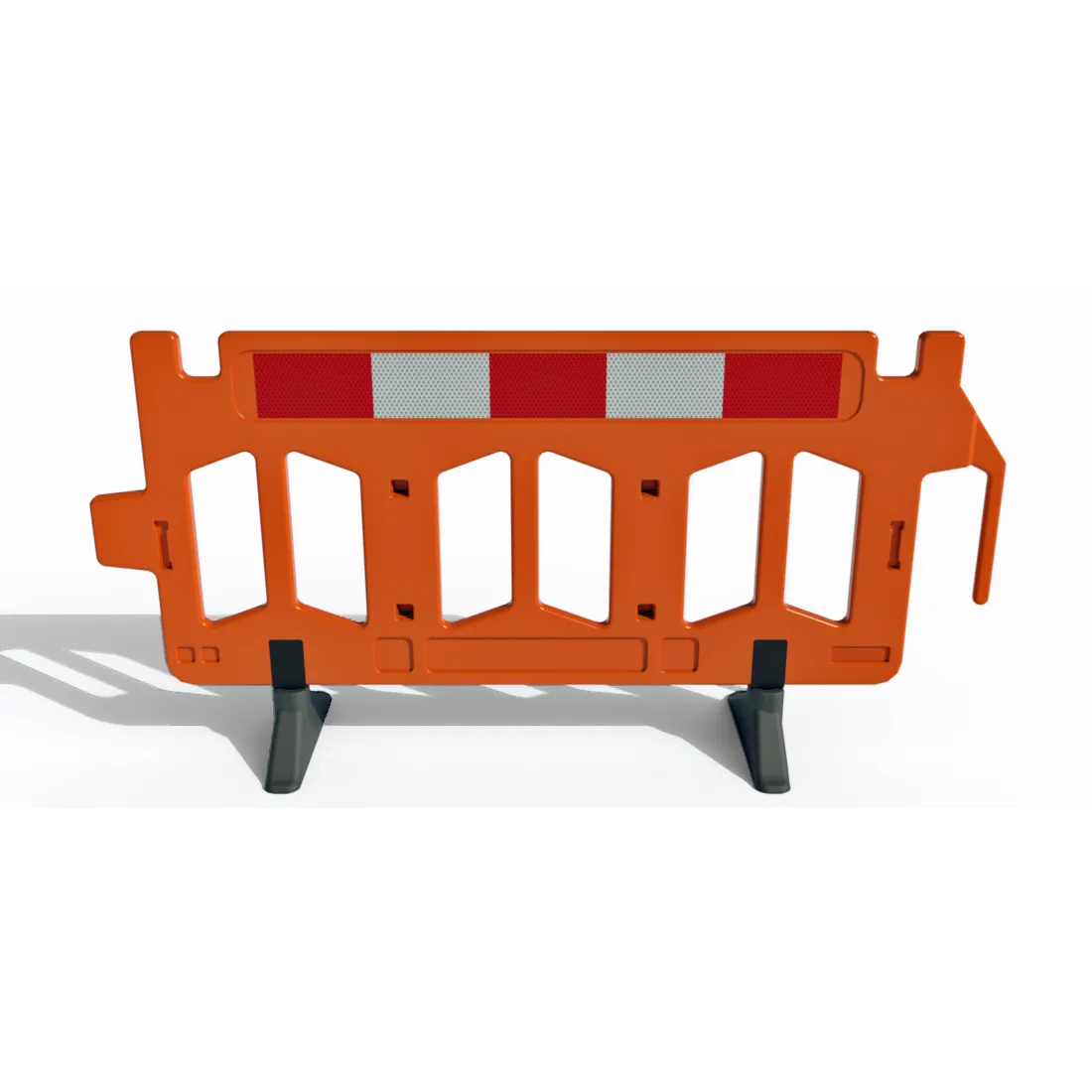
Please note: Images are for illustration purposes only. Actual product supplied may differ.
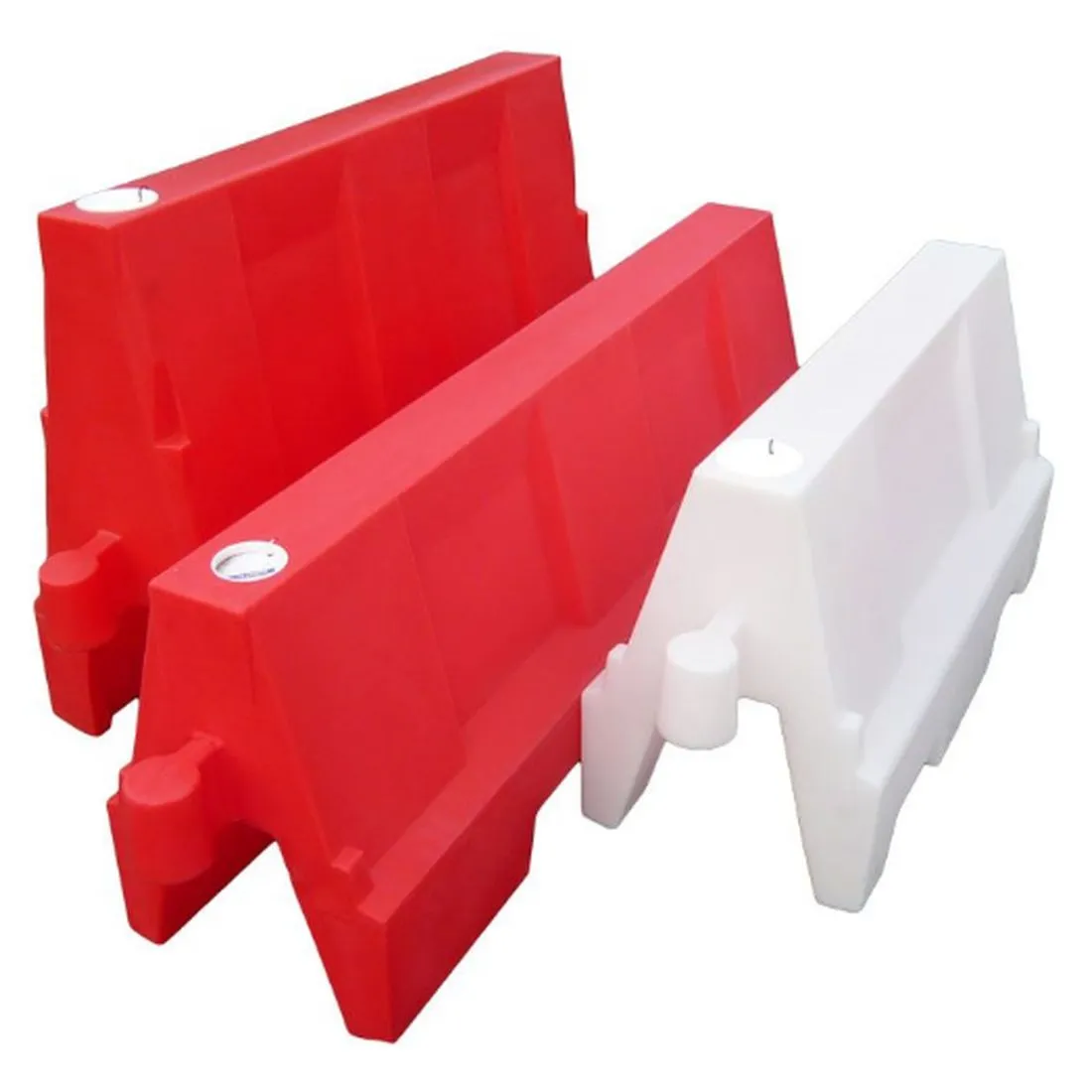
Product name: 2M Guard Barrier
Product code: 53155
- Free standing with 360 degree swivel feet for positioning
- UVHDPE construction, high impact strength and durability
- Free from screws and rivets
- Up to 50 barriers per pallet
- Barrier to barrier connection is quick and easy to use on uneven ground
- Chapter 8 BS compliant Barrier and Reflector for pedestrian delineation
- Can withstand three different classes of wind speeds with ballasts as defined by the standard BS8442;2006
- Length: 200cm
We recommend you wear steel toe protection when using this product.
Protect against falling objects. Compulsory on site.
You will need a vehicle at least the size of a truck to collect this item.
2M Guard Barrier
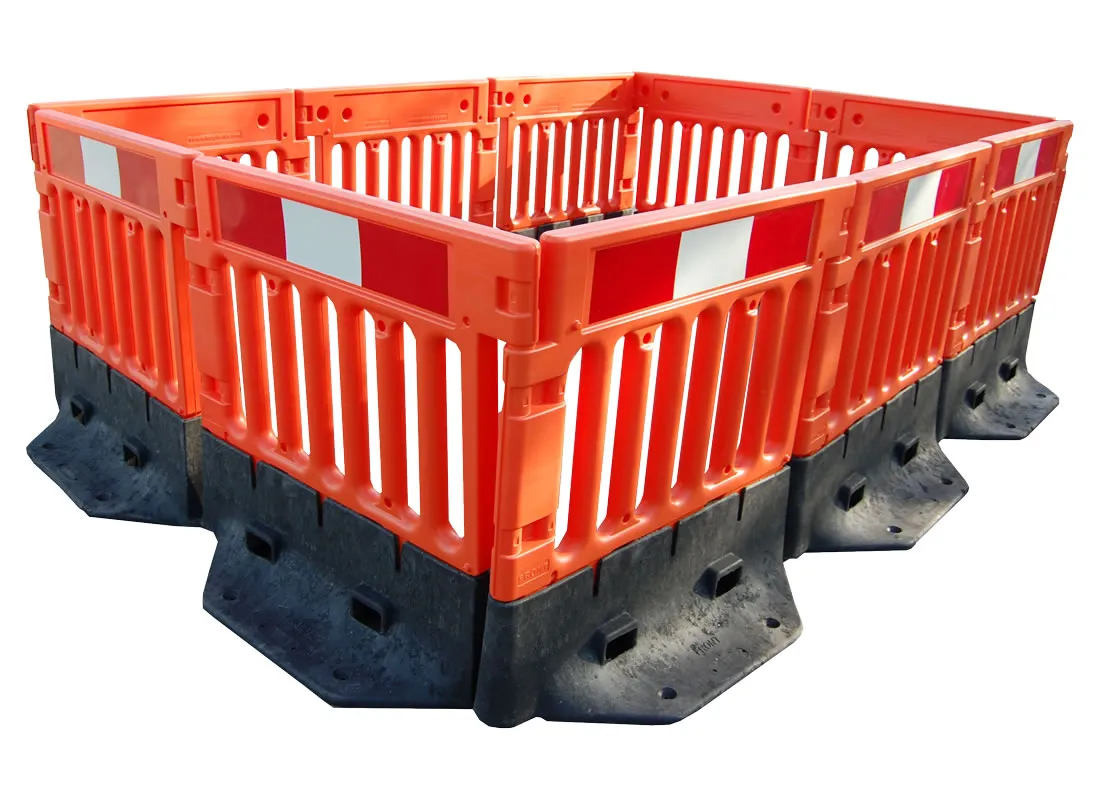
Conforming to all mandatory regulations, these highly visible 2-metre-long guard barriers are ideal when you need a temporary boundary around roadworks, groundwork and open excavations.
Hire from
£9.60 £8.00 ex.VAT
Average hire period: 7 days
You have selected a 7 day hire
Product name: 2M Guard Barrier
Product code: 53155
- Free standing with 360 degree swivel feet for positioning
- UVHDPE construction, high impact strength and durability
- Free from screws and rivets
- Up to 50 barriers per pallet
- Barrier to barrier connection is quick and easy to use on uneven ground
- Chapter 8 BS compliant Barrier and Reflector for pedestrian delineation
- Can withstand three different classes of wind speeds with ballasts as defined by the standard BS8442;2006
- Length: 200cm
We recommend you wear steel toe protection when using this product.
Protect against falling objects. Compulsory on site.
You will need a vehicle at least the size of a truck to collect this item.
Questions
A 2M Guard Barrier is used to create a temporary, highly visible boundary around hazardous areas including roadworks, excavations, groundwork, utility works, and construction sites to separate pedestrians and workers from the risk zone. The 2M Guard Barrier is also widely used at outdoor events, festivals, and public spaces to manage crowd flow, define access routes, and establish controlled perimeters at temporary venues.
Yes. 2M Guard Barriers are designed to connect end-to-end, forming continuous perimeters of any required length. The connection system works on uneven and sloped ground, allowing a consistent barrier line to be maintained across sites where the terrain is not level — which is typical on construction sites and outdoor events. Multiple barriers can be connected in a straight run, around corners, or in curved configurations to suit the site layout.
Yes, they’re made from durable UV-stabilised HDPE, meaning they can withstand outdoor conditions without fading or weakening.
Yes. 2M Guard Barriers conform to Chapter 8 of the BS8442:2006 standard for road restraint systems and pedestrian barriers used at road works and on public highways. Compliance with this standard is a requirement for contractors deploying barriers on public roads and footways under the Traffic Management Act — using non-compliant barriers on a public highway creates a legal liability for the site operator.
Each 2M Guard Barrier includes a top-mounted reflective panel that returns headlight and ambient light at night and in low-light conditions, making the barrier line clearly visible to approaching drivers and pedestrians. This reflective element is part of the BS8442:2006 compliance specification for barriers deployed at roadworks on public highways, where nighttime visibility is a statutory requirement
No. 2M Guard Barriers are entirely free-standing — they require no ground fixings, anchor bolts, or adhesives to deploy. The 360-degree swivel feet at the base adjust automatically to the ground surface angle, providing stable contact on flat, uneven, and sloped surfaces without the barrier rocking or leaning. For exposed sites or high-wind environments, ballast weights can be added to the base to increase stability.
Yes. When fitted with ballast weights, 2M Guard Barriers can withstand multiple wind speed classes as defined in BS8442:2006 — the specific wind resistance class depends on the ballast configuration used. On open, exposed sites or in areas where higher wind speeds are expected, adding ballast weights is essential to maintain barrier stability and comply with the standard's requirements for wind-loaded temporary barriers at road works.
Yes. 2M Guard Barriers are lightweight and designed for rapid deployment — the tool-free connection system requires no screws, rivets, or specialist equipment, and each barrier locks to the next in seconds. Up to 50 barriers can be stacked flat on a single pallet for efficient transport and storage, making a 2M Guard Barrier a practical choice for large-scale deployments where significant linear footage of barrier is required on a single site.
The 360-degree swivel feet allow flexible placement and make it easier to set up barriers on uneven or sloped ground.
: No. 2M Guard Barriers are designed for completely tool-free assembly and connection. The barrier body contains no screws or rivets, and the end-connection system locks barriers together without any additional fixings or equipment. This allows a continuous barrier run to be set up and taken down quickly by a single person, significantly reducing the labour time associated with establishing and repositioning a site perimeter.
Yes. 2M Guard Barriers are widely used for pedestrian management at construction sites, outdoor events, concerts, sporting events, and public spaces — channelling foot traffic along defined routes, separating pedestrians from vehicle movements, and establishing controlled access points. The 2M height provides a highly visible physical boundary that is more effective at directing pedestrian movement than barrier tape or cones, which are more easily crossed or displaced.
Yes. 2M Guard Barriers are manufactured from impact-resistant UV-stabilised HDPE, which retains its structural integrity and colour across repeated hire cycles and extended outdoor deployment. After use, barriers should be cleaned of mud and debris before stacking and storage — the pallet-stackable design makes this straightforward and keeps stored barriers compact. Inspect each barrier for cracking or connection damage before redeployment.
Yes. On open or exposed sites where higher wind speeds are expected, ballast weights should be added to the base of each 2M Guard Barrier. Ballasting is also required to achieve the higher wind speed resistance classes defined in BS8442:2006 — an unballasted 2M Guard Barrier may only meet the lower wind loading classes, which may be insufficient for sites on open roads, elevated positions, or coastal locations. Consult the hire documentation for the specific ballast requirements for each wind class.
Absolutely, they’re widely used across construction and civil engineering projects to define boundaries and improve on-site safety.
Yes, they can be hired individually or in bulk, depending on the size of the area you need to secure.
Related products
Related posts
Hire from
£9.60


