














⏱ Read time: 12 min | 🔧 Difficulty: Easy | ⏰ Time: Half a day | 👷 1 person
The lights go out, the freezer starts thawing, and the boiler dies with it. A generator can fix all three issues. The only real question is whether you hire a generator when the weather turns, or buy a generator and keep it in the shed.
We’ve compared the two to help you decide.
Why do winter power cuts catch so many of us out?
Winter power cuts catch us off guard because they arrive with almost no warning and last far longer than anyone expects.
Take Storm Éowyn in January 2025. Across Great Britain, around 621,000 homes and buildings were reconnected by network engineers, and roughly 3,000 were still sitting in the dark the following Tuesday, according to the Energy Networks Association. Not hours. Days.
That is the bit people underestimate. A four hour power outage is an inconvenience and a candlelit takeaway. A three day outage is a defrosted freezer, a cold house and a very grumpy household.
Did you know you may be able to claim compensation from your network operator for a long cut? Check out ofgem’s website for more info.
Before you shop for anything, do two quick jobs:
- Sign up to your supplier’s Priority Services Register if anyone in the house relies on powered medical equipment
- Bookmark the Met Office warnings page to regularly check the weather.
Should you hire or buy a generator?
Hire or buy: how do the costs really stack up?
That fuel point is worth pausing on. Government guidance notes that some petrol powered garden equipment and machinery may not be compatible with E10 petrol, and that E5 super grade remains available at larger forecourts.
Check your generator’s manual before you fill a jerry can and leave it until March.
What size generator do I actually need?
If you’re unsure about the size of generator you need, first add up the watts of everything you'll run at once. Next, add the startup surge of your biggest motor, then add another 25% on top. Match that total to the generator's continuous output — not the maximum figure on the box.
For example - say you want to run a 500W work light and a 1kW electric concrete mixer:
- Running total: 500W + 1,000W = 1,500W
- The mixer's motor pulls around 3,000W as it starts, so add the extra 2,000W on top: 3,500W
- Add 25% breathing room: around 4,400W
A 1kW concrete mixer needs about 3kW for the split second its motor starts up, then settles back to 1kW. That startup surge is what catches people out — a generator sized to the running figure will trip the moment you switch the mixer on.
Fair warning: A 3kW kettle will max out a small generator all by itself. Instead, boil water on a gas hob or camping stove instead and save the wattage for the freezer — though a full freezer will hold its temperature for a day or more unopened, so it only needs a few hours of power to see it through.
How do I get power cut ready, step by step?
Do this on a dry Saturday morning rather than by torchlight in a gale.
Step 1. Work out your must haves.
Walk the house and list what you can’t afford to go off: fridge freezer, boiler, router, one or two lamps, a phone charger. Add up the watts using the table above.
Step 2. Pick your machine.
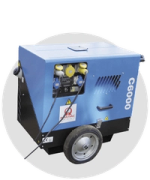
For most homes, something in the 2kVA to 4kVA bracket covers it. Our 2.6kVA portable petrol generator suits the essentials. The 4kVA petrol generator gives you 110V or 240V and runs several things at once. If noise matters, a 6kVA silenced diesel keeps the neighbours on side. To own rather than rent, the Evolution GEN2800 is a solid domestic choice.
Step 3. Order the extras with it.
Outdoor rated extension leads, an RCD power breaker, ear defenders, gloves and a fuel can. Add them to the same order and you are done in one go.
Step 4. Choose the spot now, not later.
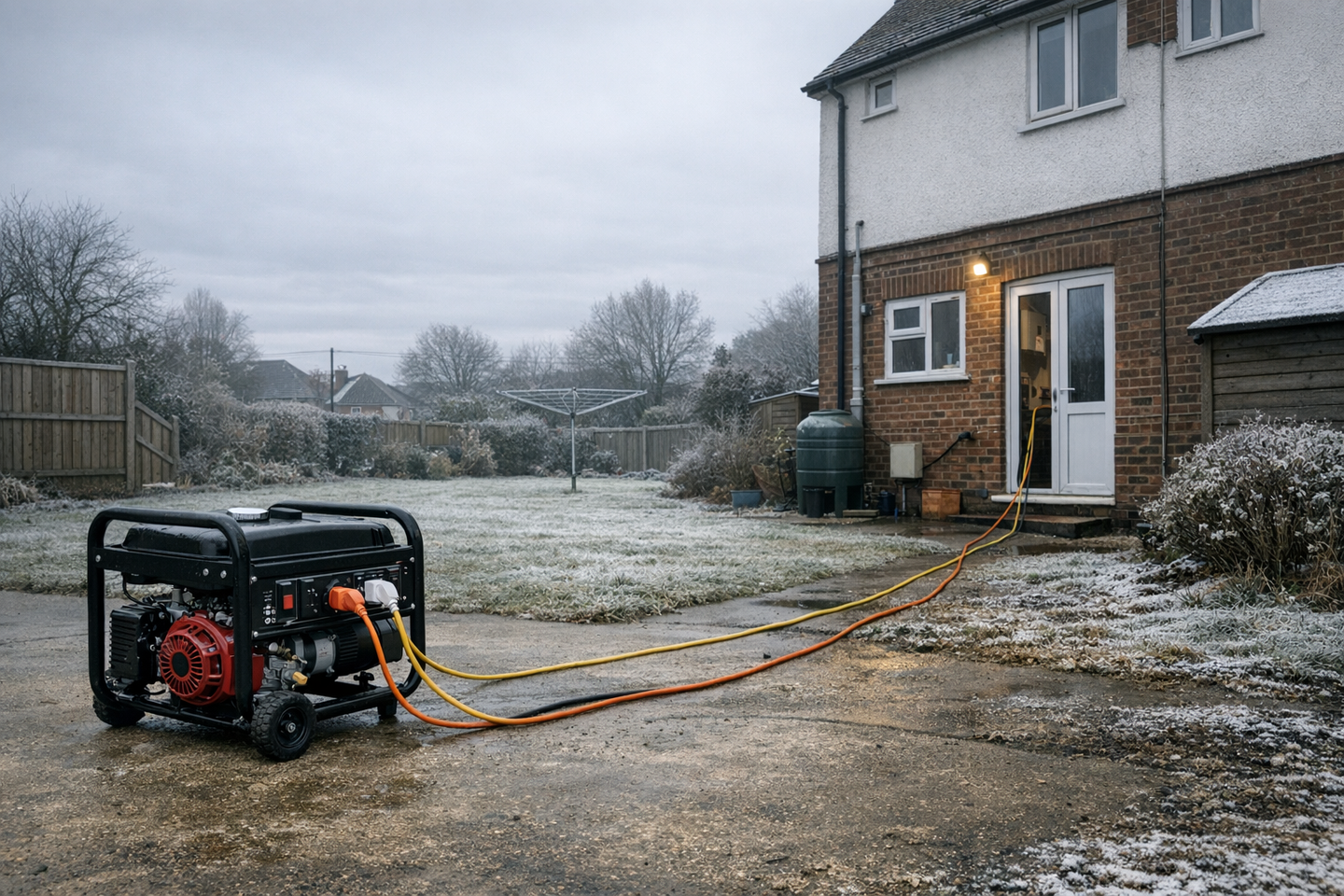
Outside, on level ground, at least a few metres from any door, window or air brick. Never in a garage, shed, porch or conservatory. Work out the cable run and check your leads reach.
Step 5. Test run it under load.
Fire it up, plug in the fridge and a lamp, and leave it 20 minutes. Better to find a problem now. Note the start procedure on a card and tape it to the machine, because nobody reads a manual in the rain.
Step 6. Brief the household.
Everyone should know where the kit lives, who starts it, and the rule that it never comes indoors. Not once. Not even in the porch.
What health and safety tips should I never skip?
You should skip any health and safety tips! They’re put in place to make sure no harm comes to you and others whilst you work, so have a read of our H&S pointers for using a generator and do not miss any out.
- Run the generator outdoors only: Carbon monoxide is the number 1 pointer when talking about generator health & safety. Petrol and diesel engines produce it in masses, it has no smell, and it kills. Never run it in a partially enclosed space, always in the open air.. Fit a carbon monoxide alarm in the house as a backstop, and our guide on where to install a carbon monoxide detector shows the right spots.
- Never plug a generator into a wall socket to feed the house: Back feeding sends power onto the network and can seriously injure whoever is out there repairing the line. If you want your circuits to run from a generator, a qualified electrician must install a proper changeover switch.
- Refuel only when the engine is off and cool: Petrol vapour on a hot exhaust is how sheds catch fire. Keep a fire extinguisher nearby and store fuel in a proper can, away from the house.
- Protect the electrics: Use an RCD, use outdoor rated leads, and uncoil cable reels fully before loading them. Electrical Safety First has clear guidance on extension leads and cable reels, and our cable reels and site lighting range covers the hardware.
- Wear the right kit: Gloves, eye protection and hearing protection. A petrol generator at close range is louder than most people expect. Have a look through our PPE range.
How long does the whole job take?
Your winter power cut checklist
Print it off, pin it inside the shed door and tick it as you go.
Before the storm
☐ List the appliances that genuinely cannot go off
☐ Add up running watts, then allow for start up surge
☐ Decide hire or buy based on how often you will use it
☐ Choose your generator size and check availability
☐ Order outdoor rated extension leads
☐ Order an RCD power breaker
☐ Order ear defenders, gloves and eye protection
☐ Buy a fuel can and the correct grade of petrol or diesel
☐ Fit and test a carbon monoxide alarm in the house
☐ Check the fire extinguisher is in date
☐ Charge every power bank in the house
Setting up
☐ Site the generator outdoors on level ground
☐ Keep it well clear of doors, windows and air bricks
☐ Confirm cable runs reach, and uncoil reels fully
☐ Test run under load for 20 minutes
☐ Write the start procedure on a card and attach it
☐ Show one other person how to start it
During a power outage
☐ Report the cut to your network operator
☐ Keep the freezer door shut until the generator is running
☐ Start the generator outdoors, then plug appliances in
☐ Never run it indoors or in a garage, even with the door open
☐ Switch off and let it cool before refuelling
☐ Keep children and pets away from the unit
Afterwards
☐ Let it cool, then clean it down
☐ Drain or stabilise fuel if it is going into storage
☐ Return hire kit, or store owned kit dry and ventilated
☐ Restock fuel and note anything that needs replacing
What HSS DIY customers say
⭐⭐⭐⭐⭐ “Good bit of kit.” - Daniel’s review on our 2.6kVA generator.
⭐⭐⭐⭐⭐ “Fast and speedy delivery and reasonable price.” - Scott’s review on our service.
You can read more verified customer reviews on Trustpilot.
Frequently asked questions
Is it cheaper to hire or buy a generator?
It depends entirely on frequency. Hiring keeps the upfront cost low and includes servicing, so it usually wins for occasional use. Buying gets cheaper per use the more you run it, which suits properties that lose power most winters. Compare live prices on our generator hire and generators to buy pages.
Can I plug a generator into my house sockets?
No. Back feeding through a socket is dangerous and can injure network engineers working on the line. If you want to power your home circuits, a qualified electrician needs to install a changeover switch. Otherwise, plug appliances directly into the generator using outdoor rated leads.
What size generator do I need for a power outage at home?
Most households manage on 2kVA to 4kVA, which covers a fridge freezer, boiler controls, lighting, a router and chargers. Skip high wattage items like kettles and electric showers.
Can I run a generator in my garage or shed with the door open?
Never. Carbon monoxide builds up in any partially enclosed space, and an open door does not make it safe. Always run a generator outdoors and in the open air, always.
How long will a generator run on one tank?
It varies by size and load. Our 4kVA petrol generator runs up to three hours continuously at over 3kVA on three litres, and across our wider power range runtimes stretch from three to 24 hours. Keep spare fuel in a proper can.
Can I get a generator delivered before a storm hits?
Usually, yes. You can hire a generator or buy one online 24/7 and choose next day delivery. Order early in the week when a warning is forecast, because demand climbs fast. If your order has several items, they may arrive separately.
The bottom line on hiring or buying generators
And that’s a wrap on whether to hire or buy a generator.
For most UK homes, hiring is the sensible call. You pay for the days you need it, you get a machine that’s been serviced and tested, and nothing sits in the shed all summer. If your power goes off most winters, or you have an allotment or workshop that needs power anyway, buying earns its place.
Either way, the mistake is doing nothing until the wind picks up. By spending half a day this autumn deciding, ordering and test running, and the next power outage becomes a mild inconvenience rather than a crisis. Sort the sizing, sort the safety kit, and you will have a working freezer if and when the power goes out.
Ready to get on with it? Browse generator hire, generators to buy, and everything else in our power equipment range. Need heat and light too? Our heater hire and LED lighting hire sit in the same basket. And for the rest of your list, see get your home ready for winter and the power cut essentials checklist.
Buy the materials. Hire the tools. One order. All in one place.
Get DIY Happy with The Home of Great Projects.