





With winter on its way, plenty of us are reaching for an electric heater — whether it’s to warm a home office, take the chill off a spare room, or heat a space that has no central heating at all. But before you plug in, it’s worth knowing what it will actually cost.
The good news is that working out an electric heater’s running cost is simple once you know two numbers: how much power the heater uses and how much you pay for electricity.
In this guide, we’ll show you how to do the sum, compare the running costs of the most popular heater types, and share easy ways to keep your bills down. If you already know what you need, browse our electric heater hire range.
How much does it cost to run an electric heater?
The simple formula
Every electric heater has a power rating in kilowatts (kW), usually found on the label or in the product details. Your energy bill charges you per kilowatt-hour (kWh) — that’s the energy used by running 1kW for one hour. So:
Cost per hour = heater power (kW) × electricity price (p per kWh)
You’ll find your unit rate (pence per kWh) on your energy bill or supplier app. In this guide we use 25p per kWh as an easy example.
For example, a powerful 3kW fan heater running flat out uses 3kWh in an hour, so at 25p per kWh it costs 3 × 25p = 75p an hour. A smaller 2kW heater costs 2 × 25p = 50p an hour. If your rate is different, just swap in your own figure.
Working out daily and monthly costs
To estimate a longer period, multiply the hourly cost by how long you’ll use it. Here’s a 2kW heater used for four hours each evening:
In practice, your real cost is often lower. Most heaters have a thermostat that switches the element off once the room reaches temperature, so the heater isn’t drawing full power the whole time. Remember too that your daily standing charge is paid whatever you use, so it isn’t part of the heater’s running cost.
What affects your running costs?
- Heater power: a 3kW heater uses twice as much electricity per hour as a 1.5kW one. Choosing the right size for the room is the biggest single saving.
- How long it runs: cost rises directly with hours of use, so timers and thermostats make a real difference.
- Your electricity price: electricity prices change over time and depend on your supplier, tariff, region and payment method — check your latest bill for your exact unit rate.
- Room size and insulation: a large, draughty room loses heat quickly, so the heater has to work harder and for longer.
- Target temperature: the warmer you set the thermostat, the more often the heater runs. Even a degree or two lower adds up over a winter.
Electric heater running costs by type
The table below shows typical power ratings, how much energy each heater uses in an hour at full power, and what that costs at our 25p per kWh example rate. Always check the wattage of the specific model you’re using.
*Example rate of 25p per kWh, running continuously at full power. To use your own rate, multiply the energy used per hour by your unit rate.
Cost per hour at different electricity prices
Electricity prices go up and down, so use this quick lookup to find your heater’s cost per hour at full power. Find your heater’s wattage on the left and your unit rate along the top.

Which is the cheapest electric heater to run?
Here’s something that surprises many people: almost all electric heaters turn close to 100% of the electricity they use into heat. A 2kW fan heater and a 2kW oil-filled radiator cost exactly the same to run for an hour at full power.
What makes one heater cheaper than another in practice is how much power it draws, how well it holds and spreads heat, and how good its controls are. The cheapest heater to run is the lowest-wattage one that comfortably heats your space — ideally with a thermostat and timer.
Halogen heaters
Halogen heaters use halogen bulbs to give off infrared heat, which warms people and objects directly rather than the air around them. They’re usually low-powered (around 1.2kW) and warm up almost instantly.
- Low hourly cost: one of the cheapest heaters to run per hour.
- Instant heat: no waiting for the room to warm up.
- Good for spot heating: ideal when you’re sitting in one place, or in covered or semi-outdoor spaces where warm air would escape.
The trade-off: they don’t heat a whole room well, and you lose the warmth as soon as you move out of range.
Ceramic heaters
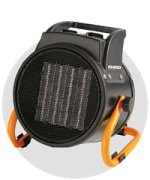
Ceramic heaters pass electricity through ceramic plates, which heat up quickly. A fan then blows air across the plates to spread warmth around the room.
- Compact and portable: easy to move between rooms.
- Quick to warm up: ceramic plates reach temperature fast and cool down safely.
- Built-in controls: many models have thermostats, so they only draw power when they need to.
They’re a great fit for small spaces like home offices, kitchens, small workshops and garages.
Oil-filled radiators
Oil-filled radiators heat oil sealed inside the fins. The warm oil circulates naturally and heats the metal, which then radiates heat into the room. The oil is never used up and never needs topping up.
- Holds heat well: the oil keeps the radiator warm after the element switches off, so the thermostat cycles less often.
- Gentle, even warmth: silent, with no fan, making them ideal for bedrooms and living rooms.
- Good controls: many have adjustable or digital thermostats and timers.
They take longer to warm up than a fan heater, so they suit longer, steadier use. Hire an oil-filled radiator.
Fan heaters
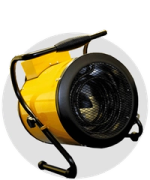
Fan heaters blow air over a hot element to push warmth quickly around a space. They’re often the most powerful portable option, typically 2kW to 3kW.
- Fastest heat-up: great for taking the chill off a cold room quickly.
- Powerful: can heat larger or draughtier spaces such as workshops and garages.
- Inexpensive to hire or buy: a low upfront cost for short-term needs.
Because they’re higher-powered, they cost more per hour, so they’re best used in short bursts or with the thermostat set sensibly. See our 2.8kW fan heater.
Storage heaters
Storage heaters charge up overnight using cheaper off-peak electricity, storing heat in ceramic bricks. They then release that heat slowly through the day.
- Use cheaper electricity: designed for Economy 7 or Economy 10 tariffs, where night-time rates are lower than the standard rate.
- Good for homes without gas: a common main heating system in all-electric properties.
- Steady background heat: warmth is available throughout the day.
Their running cost depends entirely on your off-peak rate, and they’re less flexible — if the stored heat runs out in the evening, any top-up heat is charged at the higher daytime rate.
How long does it take an electric heater to heat a room?
It depends on the type of heater, its power and the size and insulation of the room. As a rough guide:
- Halogen heaters feel warm almost instantly, because they heat you directly.
- Fan and ceramic heaters start warming a small room within minutes, as the fan spreads the heat quickly.
- Oil-filled radiators take longer to get going — often 20 minutes or more — but keep the room warm for longer once they do.
If you need heat fast, choose a fan or ceramic heater. If you’ll be in the room for hours, an oil-filled radiator gives steadier, quieter warmth.
How to reduce your electric heater running costs
1 – Use the thermostat and a timer
A thermostat stops the heater drawing power once the room is warm enough, and a timer means it only runs when you need it. Set the thermostat to a comfortable temperature rather than turning it to maximum.
2 – Only heat when and where you need it
Leaving a heater on low all day “to save energy” is a myth — electric heaters don’t use extra power to warm up, so running one for longer simply costs more. Switch it on when you’re using the room and off when you leave.
3 – Keep the heat in
Close doors, draw curtains at dusk and use draught excluders on doors and windows. The less heat you lose, the less your heater has to run.
4 – Choose the right size heater
A heater that’s too small will run constantly without getting the room warm; one that’s too big wastes energy. As a rough guide, allow around 1kW for every 10m² of a typical, reasonably insulated room, and more for draughty spaces or high ceilings.
5 – Check you’re on the right tariff
If you rely on electric heating, compare tariffs. Economy 7 and Economy 10 offer cheaper electricity at set times, which suits storage heaters — but daytime rates are usually higher, so they’re not right for everyone. Thinking about bigger changes? Read our guide to electric heaters vs gas central heating.

Electric heater running costs: FAQs
How much does a 2kW electric heater cost per hour?
A 2kW heater uses 2kWh an hour at full power, so multiply 2 by your unit rate. At 25p per kWh that’s 50p an hour. With a thermostat, the real cost is often lower.
How much does a 3kW heater cost to run?
A 3kW heater uses 3kWh an hour at full power. At 25p per kWh that’s 75p an hour, or £3.00 for four hours.
Is it cheaper to leave an electric heater on low all day?
No. An electric heater uses electricity in proportion to how long it runs and at what power, so running it all day costs more than heating the room only when you need it.
Do oil-filled radiators use less electricity?
Not per hour — a 2kW oil-filled radiator uses the same electricity as any other 2kW heater. But because they hold heat well, their thermostat switches the element on less often, which can lower the overall cost over a long session.
Is an electric heater cheaper than central heating?
Electricity costs more per kWh than gas, so heating a whole home with electric heaters is usually more expensive. But heating just one room with a portable heater can cost less than running the central heating for the whole house.
Find out more in Electric Heaters vs Gas Central Heating.
Hire heating equipment for your home or business with HSS DIY
Whether you need to warm a spare room, a home office or a busy workshop, HSS DIY has a wide range of electric heaters available to hire, from compact ceramic heaters to oil-filled radiators and powerful fan heaters.
Not sure which is right for you? Our advisory team can help you choose the most efficient heater for your space — just get in touch via live chat.
You might also find these guides helpful: Temporary Heating Solutions for the Home, Heating Solutions for the Office and A Hiring Guide to Commercial Heaters.
Meet the people behind our Tips & Advice
From quick fixes to bigger DIY projects, get to know the people behind the guides helping you get the job done with confidence.


